


World Video Game Hall of Fame Announces 2026 Class: Angry Birds, Dragon Quest, and Silent Hill Inducted
- Sagar Mankar

- May 7
- 6 min read
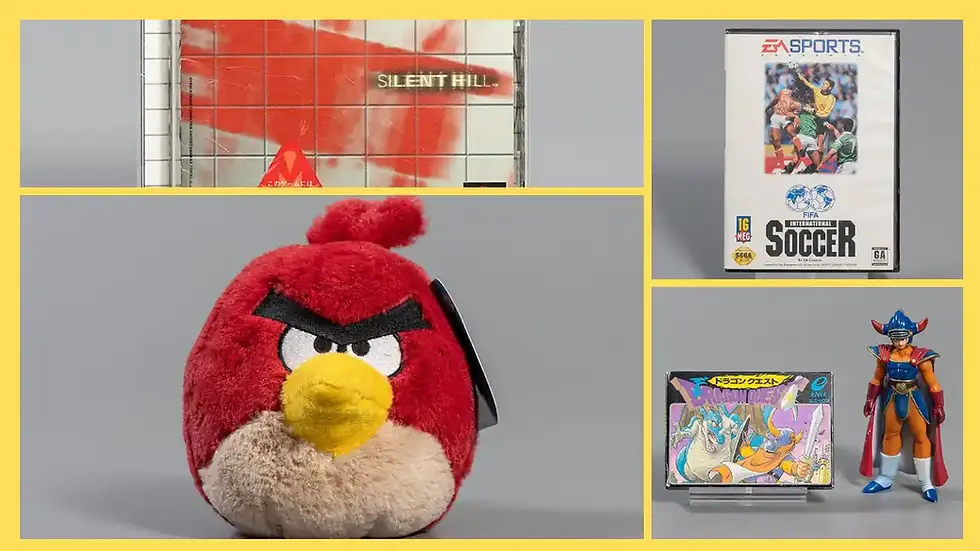
The World Video Game Hall of Fame has officially announced its 2026 inductee class, adding four titles to its growing list of iconic games recognized for their cultural and historical impact on gaming.
Located at The Strong National Museum of Play in Rochester, New York, the Hall of Fame has been honoring landmark video games since its inaugural class in 2015. This year's picks span several decades and genres, reflecting just how wide the net of gaming influence can be cast.
The 2026 Inductees
The four games joining the Hall of Fame this year are:
Angry Birds (2009, Rovio Entertainment)
Dragon Quest (1986, Chunsoft)
FIFA International Soccer (1993, EA Canada)
Silent Hill (1999, Konami)
Each of these titles left a mark that goes well beyond their release dates. Here is a closer look at why each one made the cut.
Angry Birds: Mobile Gaming's Defining Moment
When Rovio Entertainment launched Angry Birds in 2009, nobody quite expected it to reshape how the world played games. The title introduced tens of millions of people to touch-based mobile gaming, arriving right at the moment when smartphones were beginning their global takeover. Since then, the game has racked up more than 5 billion downloads worldwide, a number that speaks for itself.
What started as a physics-based puzzle game with birds and pigs has grown into a full-blown media franchise. There have been live games, licensed products, animated content, and even a film series. The Angry Birds Movie landed in theaters in 2016, followed by a sequel in 2019. A third film is currently slated for a December 2026 release.
Angry Birds Creative Officer Ben Mattes shared his thoughts on the honor. "What started as a game with incredibly simple mechanics and instantly recognizable designs has conquered transmedia categories far beyond its origins," he said.
He also added, "Characters, emotion and story are what keeps our fans coming back to our games year after year. The induction to the World Video Game Hall of Fame means we are standing shoulder to shoulder alongside the very greatest of gaming. This is a truly special recognition for us and we're deeply honored by it."
Dragon Quest: The Blueprint for the JRPG
Dragon Quest, released in 1986 for the Nintendo Famicom, did not just entertain players. It essentially invented the template for Japanese Role-Playing Games as we know them today. The game was a collaboration between scenario writer Yuji Horii, manga artist Akira Toriyama, and composer Koichi Sugiyama. Each of them brought something critical to the table.
Horii translated the complexity of Western computer RPGs into a simplified, console-friendly menu system. This made the genre accessible without stripping away depth. At the same time, he wove in branching narrative choices that had real consequences. A standout example is the game's final encounter, where the villain, the Dragonlord, offers you half the world if you abandon your quest. Accept it, and the screen turns red and black. Your choice matters, and the game makes sure you feel it.
This thoughtful approach went on to inspire titles like Earthbound and Chrono Trigger, which similarly built ethical dilemmas into their core gameplay.
Sugiyama's contributions were equally significant. He was among the first composers to treat video game music as a serious art form, and the first to use a live orchestra to record compositions for a game. That legacy echoes through franchises like Final Fantasy, Persona, and even the recent Game of the Year winner Clair Obscur: Expedition 33.
Dragon Quest's popularity in Japan was so massive that Enix reportedly shifted its release day from Thursday to Saturday so that kids would not skip school to buy the game. That kind of cultural impact is rare, even among gaming legends.
FIFA International Soccer: The World's Game, Digitized
FIFA International Soccer launched in December 1993 for the SEGA Genesis/Mega Drive, and despite its late arrival in that calendar year, it became the best-selling game in Europe for 1993, moving over 500,000 copies right out of the gate.
What set FIFA apart from earlier soccer games like Sensible Soccer and Kick Off was its isometric view, which closely mirrored televised broadcasts of real matches. EA also secured a licensing agreement with the Fédération Internationale de Football Association, soccer's global governing body, which helped give the game an air of legitimacy from the start.
By 2021, approximately 325 million games in the EA SPORTS FIFA series had been sold. The franchise generated a high percentage of EA's net profits over the years and remained the dominant sports title globally, even as rivals like Pro Evolution Soccer tried to challenge it. Today, EA continues the franchise under a new name, EA SPORTS FC.
Silent Hill: Horror That Gets Under Your Skin
Silent Hill arrived in 1999, three years after Resident Evil helped define survival horror. But while Resident Evil leaned into jump scares and action, Silent Hill took a different route. It focused on psychological dread, atmosphere, and a creeping sense of unease that stayed with players long after the screen went dark.
The game was developed by Team Silent, a Konami team led by producer and director Keiichiro Toyama. Toyama and his team actually explored the area around Chicago while developing the game, drawing on the look and feel of a small American town to build Silent Hill's unsettling setting. Classic horror elements like religious cults, the undead, and thick, impenetrable fog completed the picture.
One of the game's smartest design choices was limiting the player's field of vision. This was partly a technical workaround for rendering 3D environments on the original Sony PlayStation, but it ended up becoming one of the game's most effective horror tools. Composer and sound director Akira Yamaoka leaned into this further, using a pocket radio mechanic that produced static whenever monsters were nearby. It is a warning system that also functions as a constant source of dread.
Silent Hill sold over two million copies and launched a franchise with collective sales exceeding 14 million. A film adaptation grossed more than $100 million, and two additional movies followed. The game's lasting significance, however, lies in how it pushed horror gaming toward emotional and psychological depth.
A Look at the Full Hall of Fame Timeline
Since its founding in 2015, the World Video Game Hall of Fame has inducted a wide range of titles. Here is the complete list by year:
2015 (Inaugural Class – 6 games)
Doom (1993, id Software)
Pac-Man (1980, Namco)
Pong (1972, Atari)
Super Mario Bros. (1985, Nintendo)
Tetris (1984/1985, Alexey Pajitnov)
World of Warcraft (2004, Blizzard Entertainment)
2016 (6 games)
Grand Theft Auto III (2001, DMA Design)
The Legend of Zelda (1986, Nintendo)
The Oregon Trail (1971, Don Rawitsch et al.)
The Sims (2000, Maxis)
Sonic the Hedgehog (1991, Sonic Team)
Space Invaders (1978, Taito)
2017 (4 games)
Donkey Kong (1981, Nintendo)
Halo: Combat Evolved (2001, Bungie)
Pokémon Red and Green (1996, Game Freak)
Street Fighter II (1991, Capcom)
2018 (4 games)
Final Fantasy VII (1997, Square)
John Madden Football (1990, Park Place Productions)
Spacewar! (1962, Steve Russell et al.)
Tomb Raider (1996, Core Design)
2019 (4 games)
Colossal Cave Adventure (1976, William Crowther & Don Woods)
Solitaire (1990, Microsoft)
Mortal Kombat (1992, Midway Games)
Super Mario Kart (1992, Nintendo)
2020 (4 games)
Bejeweled (2001, PopCap Games)
Centipede (1981, Atari)
King's Quest (1984, Sierra On-Line)
Minecraft (2011, Mojang)
2021 (4 games)
Animal Crossing (2001, Nintendo)
Microsoft Flight Simulator (1982, Sublogic)
StarCraft (1998, Blizzard Entertainment)
Where in the World Is Carmen Sandiego? (1985, Broderbund)
2022 (4 games)
Dance Dance Revolution (1998, Konami)
The Legend of Zelda: Ocarina of Time (1998, Nintendo)
Ms. Pac-Man (1982, General Computer Corporation)
Sid Meier's Civilization (1991, MicroProse)
2023 (4 games)
Barbie Fashion Designer (1996, Digital Domain)
Computer Space (1971, Syzygy Engineering)
The Last of Us (2013, Naughty Dog)
Wii Sports (2006, Nintendo)
2024 (5 games)
Asteroids (1979, Atari)
Myst (1993, Cyan)
Resident Evil (1996, Capcom)
SimCity (1989, Maxis)
Ultima (1981, Richard Garriott / Origin Systems)
2025 (4 games)
Defender (1981, Williams Electronics)
GoldenEye 007 (1997, Rare)
Quake (1996, id Software)
Tamagotchi (1996, Bandai)
2026 (4 games)
Angry Birds (2009, Rovio Entertainment)
Dragon Quest (1986, Chunsoft)
FIFA International Soccer (1993, EA Canada)
Silent Hill (1999, Konami)
