


Sony Faces Backlash as "Don't Kill the Disc" Petition Hits 200,000 Signatures


A Change.org petition asking Sony to keep physical PlayStation game discs alive has crossed 200,000 signatures in less than a week.
The petition, titled "Don't Kill the Disc: Tell Sony to Keep Physical PlayStation Games," was started by a small Canadian retailer and has quickly turned into one of the loudest consumer pushbacks the gaming industry has seen in a while.
The frustration comes from a Sony announcement on July 1, 2026, stating that production of physical discs for all new PlayStation games will end by January 2028. After that date, new titles will only be available digitally through the PlayStation Store, or as code in box editions that come with packaging but no actual disc inside. Games that release before the cutoff, along with existing physical titles, will not be affected.
Sony framed the decision as a response to "shifting trends in consumer preference." Sid Shuman, Senior Director of Content Communications at Sony, said the shift lines up with how most players already access their games today, since digital downloads have been outpacing physical sales for a while now.
The timing did not help calm nerves either. This news came right after Rockstar Games confirmed that Grand Theft Auto VI would only launch with download codes, which only added to fears that other publishers might follow Sony's lead.
For a lot of gamers though, this isn't really about convenience. It's about ownership, and whether that idea is slowly disappearing.
The Petition That Blew Up Fast
Jade Pearce, CEO of PNP Games Inc., launched the petition almost immediately after Sony's statement dropped. It crossed 40,000 signatures within 48 hours, then hit 100,000 by day four. From there it just kept climbing, moving past 130,000, then 170,000, and now sitting above the 200,000 mark.
The petition's core message is clear:
"A disc is a real game you own. You can lend it, trade it, resell it, gift it, collect it, or pass it down to your kids. A box with only a download code is not the same thing. It is a digital license in plastic packaging. You do not own it. You are renting access that can be revoked, and people have already had purchased movies deleted from their libraries and games pulled from sale weeks after launch."
It also makes a point of saying supporters aren't against digital gaming as a whole. The issue is digital becoming the only choice. Pearce has also pointed out the economic side of things, noting that physical games support retailers, distributors, warehouses, and the pre-owned market, all of which could take a hit once new discs stop being made.
What Happens From Here?
Petitions like this rarely force big companies to reverse course completely, but 200,000 signatures in under a week is hard to ignore. The backlash hasn't stayed confined to angry comments either. It has spilled out into memes, boycott threats like "Not buying PS6," and even cancellations of PS Plus subscriptions. At some point, even brands outside gaming couldn't resist joining in.
Domino's Pizza UK was one of the first to jump in, quote tweeting Sony's announcement with a jab of its own: "Makes about as much sense as us changing to digital pizzas." They didn't stop there. A full satirical press release followed, announcing the end of physical pizzas in favor of "downloadable pizza codes."

KFC Spain posted its own mock announcement, stating, "BREAKING NEWS: KFC will stop offering its physical format starting today. Products can only be consumed through our app in fake PNG format."

Beyond the humor though, some voices treated the topic more seriously. Comedian and former talk show host Trevor Noah spoke out against the move, pointing out how physical discs make sharing and affordability possible through the second-hand market, something that matters a lot for players who rely on it.

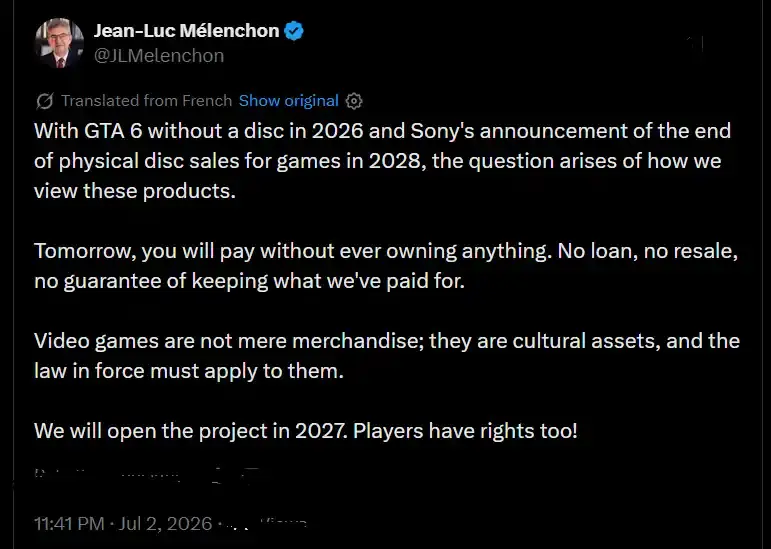
French politician Jean-Luc Mélenchon also chimed in, raising concerns about digital licenses that can be revoked at any time.
It wasn't just players and internet personalities pushing back either. Developers, publishers, and retailers had their own concerns to share. Hideo Kojima called parts of the shift "really sad," while several preservation groups (like Stop Killing Games, Internet Archive, and Video Game History Foundation) and independent game stores pointed to potential job losses and reduced game discoverability down the line.

Through all of this, Sony has stayed mostly quiet, offering nothing beyond its original statement. But with signatures still climbing and the internet clearly not letting this go, staying silent for much longer might not be the easiest option.


Comments